7q11.23 Copy Number Variation
Description
DuplicationDeletion
7q11.23 copy number variation syndrome (MIM#609757, also called Williams-Beuren region duplication syndrome, WBS duplication syndrome, Chromosome 7q11.23 duplication syndrome, or Somerville-van-der-Aa syndrome) is a duplication syndrome. The breakpoints are defined from Mervis et al., 2015.
- Region size (GRCh37)
- 1.4 Mb (GRCh38: 1.4 Mb)
- Genes in region
- 23 (23 protein-coding)
- Data version
- v_2026-10-22
Genomic location
Coordinates:
Disorder information from Orphanet
7q11.23 microduplication syndrome is a rare chromosomal anomaly syndrome resulting from the partial duplication of the long arm of chromosome 7 characterized by a highly variable phenotype that typically manifests with mild to moderate intellectual disability (patients could be in the normal range), speech disorders (particularly of expressive language), and distinctive craniofacial features (brachycephaly, broad forehead, straight eyebows, broad nasal tip, short philtrum, thin upper lip and facial asymmetry). Hypotonia, developmental coordination disorders, behavioral problems (such as anxiety, ADHD and oppositional disorders) and various congenital anomalies, such as heart defects, diaphragmatic hernia, renal malformations and cryptorchidism, are frequently presented. Neurological abnormalities (visible on MRI) have been reported.
A rare genetic multisystemic neurodevelopmental disorder characterized by a distinct facial appearance, cardiac anomalies (most frequently supravalvular aortic stenosis), cognitive and developmental abnormalities, and connective tissue abnormalities (e.g., joint laxity). Facial dysmorphism is characterized by a broad forehead, bitemporal narrowing, periorbital fullness, stellate and/or lacy iris pattern, short upturned nose with bulbous tip, long philtrum, wide mouth, full lips and mild micrognathia.
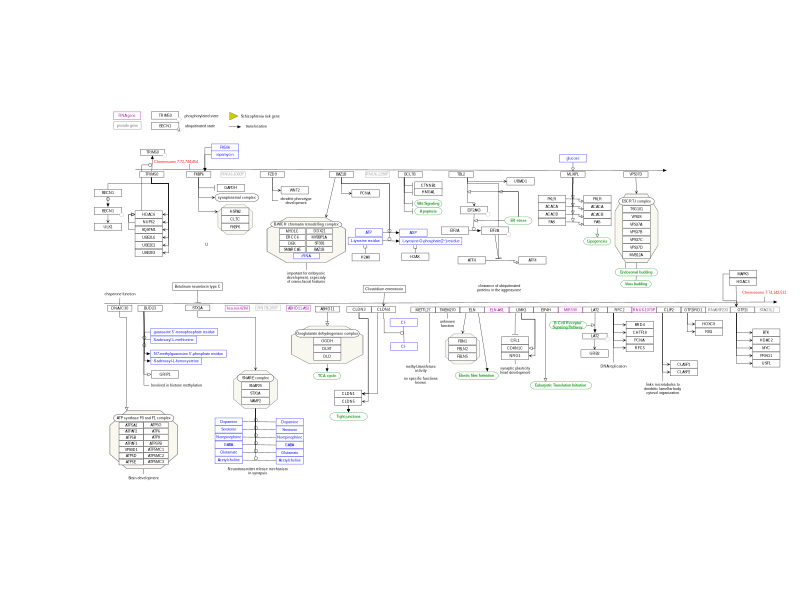
Molecular pathway
Gene information
Genes marked ● are also in the molecular pathway.
| HGNC | Gene name | Locus group | NCBI | Ensembl | UniProt | OMIM |
|---|---|---|---|---|---|---|
| FKBP6 ● | FKBP prolyl isomerase family member 6 (inactive) | protein-coding gene | 8468 | ENSG00000077800 | O75344 | 604839 |
| FZD9 ● | frizzled class receptor 9 | protein-coding gene | 8326 | ENSG00000188763 | O00144 | 601766 |
| BAZ1B ● | bromodomain adjacent to zinc finger domain 1B | protein-coding gene | 9031 | ENSG00000009954 | Q9UIG0 | 605681 |
| BCL7B ● | BAF chromatin remodeling complex subunit BCL7B | protein-coding gene | 9275 | ENSG00000106635 | Q9BQE9 | 605846 |
| TBL2 ● | transducin beta like 2 | protein-coding gene | 26608 | ENSG00000106638 | Q9Y4P3 | 605842 |
| MLXIPL ● | MLX interacting protein like | protein-coding gene | 51085 | ENSG00000009950 | Q9NP71 | 605678 |
| VPS37D ● | VPS37D subunit of ESCRT-I | protein-coding gene | 155382 | ENSG00000176428 | Q86XT2 | 610039 |
| DNAJC30 ● | DnaJ heat shock protein family (Hsp40) member C30 | protein-coding gene | 84277 | ENSG00000176410 | Q96LL9 | 618202 |
| BUD23 ● | BUD23 rRNA methyltransferase and ribosome maturation factor | protein-coding gene | 114049 | ENSG00000071462 | O43709 | 615733 |
| STX1A ● | syntaxin 1A | protein-coding gene | 6804 | ENSG00000106089 | Q16623 | 186590 |
| ABHD11 ● | abhydrolase domain containing 11 | protein-coding gene | 83451 | ENSG00000106077 | Q8NFV4 | 621050 |
| CLDN3 ● | claudin 3 | protein-coding gene | 1365 | ENSG00000165215 | O15551 | 602910 |
| CLDN4 ● | claudin 4 | protein-coding gene | 1364 | ENSG00000189143 | O14493 | 602909 |
| METTL27 ● | methyltransferase like 27 | protein-coding gene | 155368 | ENSG00000165171 | Q8N6F8 | 612546 |
| TMEM270 ● | transmembrane protein 270 | protein-coding gene | 135886 | ENSG00000175877 | Q6UE05 | 612547 |
| ELN ● | elastin | protein-coding gene | 2006 | ENSG00000049540 | P15502 | 130160 |
| LIMK1 ● | LIM domain kinase 1 | protein-coding gene | 3984 | ENSG00000106683 | P53667 | 601329 |
| EIF4H ● | eukaryotic translation initiation factor 4H | protein-coding gene | 7458 | ENSG00000106682 | Q15056 | 603431 |
| LAT2 ● | linker for activation of T cells family member 2 | protein-coding gene | 7462 | ENSG00000086730 | Q9GZY6 | 605719 |
| RFC2 ● | replication factor C subunit 2 | protein-coding gene | 5982 | ENSG00000049541 | P35250 | 600404 |
| CLIP2 ● | CAP-Gly domain containing linker protein 2 | protein-coding gene | 7461 | ENSG00000106665 | Q9UDT6 | 603432 |
| GTF2IRD1 ● | GTF2I repeat domain containing 1 | protein-coding gene | 9569 | ENSG00000006704 | Q9UHL9 | 604318 |
| GTF2I ● | general transcription factor IIi | protein-coding gene | 2969 | ENSG00000263001 | P78347 | 601679 |
Evidence
- Loading citation... [PMID: 33610060]
- Loading citation... [PMID: 20089974]
- Loading citation... [PMID: 19249392]
- Loading citation... [PMID: 26610320]