2q21.1 Copy Number Variation
Description
The 2q21.1 copy number variation syndrome can result in the loss of up to 9 protein-coding genes. Deletions and duplications in 2q21.1 were reported to be connected to intellectual disability, hyperactivity, and aggressive behavior (Almuzzaini et al., 2020; Gimelli et al., 2014). The clinical picture was explained by alterations in five genes important for neurological development, namely GPR148, FAM123C, ARHGEF4, FAM168B and PLEKHB2 (Gimelli et al., 2014; Dharmadhikari et al., 2012). Analogically, changes in tubulin genes in 2q21.1 were linked to Motor Timing in ADHD (Rommelse et al., 2008). For this rare disorder, two different genomic locations are known according to Kirov et al. 2014, and Gimelli et al. 2014 with a larger deletion.
- Region size (GRCh37)
- 0.45 Mb (GRCh38: 0.45 Mb)
- Genes in region
- 5 (5 protein-coding)
- Data version
- v_2026-10-22
Genomic location
Coordinates:
Disorder information from Orphanet
This CNV is not yet linked to an ORPHAcode.
Molecular pathway
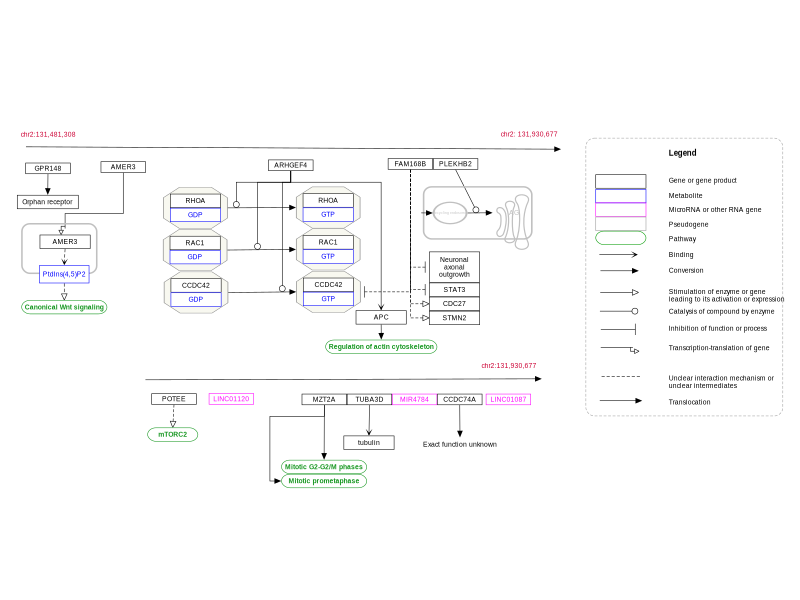
Gene information
Genes marked ● are also in the molecular pathway.
| HGNC | Gene name | Locus group | NCBI | Ensembl | UniProt | OMIM |
|---|---|---|---|---|---|---|
| GPR148 ● | G protein-coupled receptor 148 | protein-coding gene | 344561 | ENSG00000173302 | Q8TDV2 | |
| AMER3 ● | APC membrane recruitment protein 3 | protein-coding gene | 205147 | ENSG00000178171 | Q8N944 | |
| ARHGEF4 ● | Rho guanine nucleotide exchange factor 4 | protein-coding gene | 50649 | ENSG00000136002 | Q9NR80 | 605216 |
| FAM168B ● | family with sequence similarity 168 member B | protein-coding gene | 130074 | ENSG00000152102 | A1KXE4 | 620078 |
| PLEKHB2 ● | pleckstrin homology domain containing B2 | protein-coding gene | 55041 | ENSG00000115762 | Q96CS7 | 618452 |
Evidence
- Loading citation... [PMID: 22543972]
- Loading citation... [PMID: 24591035]
- Loading citation... [PMID: 25661985]
- Loading citation... [PMID: 31989799]
- Loading citation... [PMID: 18599010]
- Loading citation... [PMID: 23992924]